• Drug Policy

    Transitions to legal cannabis markets

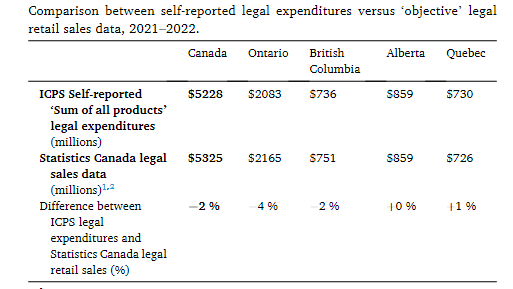
    Legal market capture of cannabis expenditures in Canada following federal cannabis legalization

    Highlights

    •Legal market capture of cannabis 5 years post-legalization in Canada is ∼78 %.

    •Dried flower accounted for approximately 60 % of all legal cannabis expenditures.

    •Higher legal market capture for drinks, vapes, and capsules; lower for concentrates.

    •Overall, evidence of substantial transition in expenditures from illegal to legal cannabis market.

    Read more in the International Journal of Drug Policy

  • Drug Policy

    Estimates of Illicit Opioid Use in the US

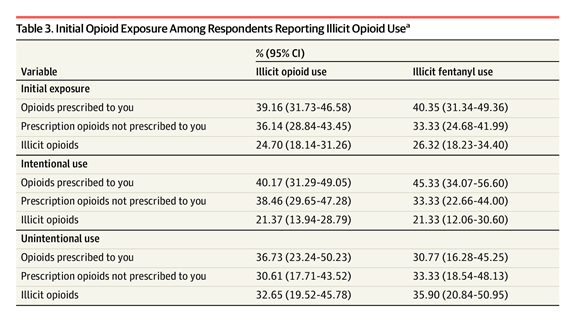
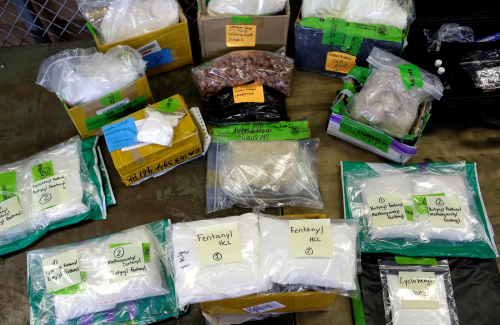
    The opioid crisis represents one of the greatest public health challenges of our time, yet estimates of illicit opioid use are rare and typically available only years after data collection, limiting our ability to monitor trends in prevalence. This survey study estimated near real-time rates of illicit opioid use.

    These findings suggest that illicit opioid use and, in particular, IMF use is more prevalent than previously estimated. Almost 11% of the population aged 18 years and older reported using illicit opioids within the past 12 months, including 7.5% of the population aged 18 years and older using IMF.

    Research critical of prior survey evidence on illicit substance use estimated that the true rate of chronic heroin use was more than 16 times the rate reported in the NSDUH. Our estimate of IMF use is 25 times as large as the 2022 NSDUH rate for those aged 18 years or older (7.5% vs 0.3%). Assuming that illicit opioid use has increased, these differences are consistent with prior estimates of NSDUH undercounts of illicit opioid use.

    Read more: JAMA Health Forum. 2025;6(5):e250809. doi:10.1001/jamahealthforum.2025.0809

  • Drug Policy

    Criminalizing Substance Use And Homelessness Harms Public Health And Safety

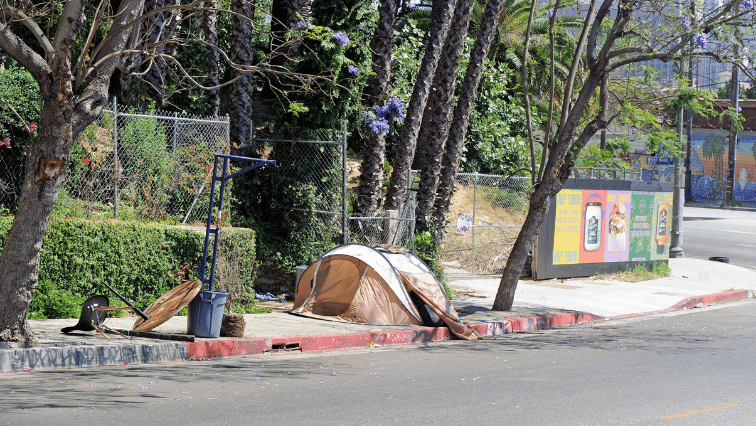
    Such policies reflect public fears about substance use and issues associated with people living without shelter, but they stem from flawed narratives that people who use drugs and are unhoused are dangerous and the assumption that harsher penalties for substance use and homelessness improve public safety. Evidence shows otherwise. These narratives also fail to account for this population’s extensive health and social needs. Consequently, these laws will expose more vulnerable individuals to the harms of incarceration, fail to improve public safety, and exacerbate the homelessness crisis. To address drug use and homelessness, policy makers and public health experts should prioritize evidence-based alternatives to criminalization that improve public health and safety.


    Read more at Health Affairs

  • Drug Policy

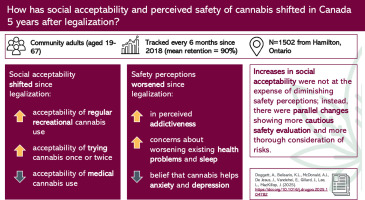
    Changes in cannabis attitudes and perceptions in the five years following recreational legalization in Canada

    Highlights

    •Those not using cannabis pre-legalization showed steeper increases in acceptability.

    •Social acceptability of recreational cannabis use has increased since legalization.

    •Social acceptability of medical cannabis use declined.

    •Regular cannabis use perceived as riskier and more addictive.

    •Declines in perceived health-related benefits; increases in health-related risks.

    Read more in the International Journal of Drug Policy

  • Drug Policy

    Cannabis Use and Misuse Following Recreational Cannabis Legalization

    Key Points

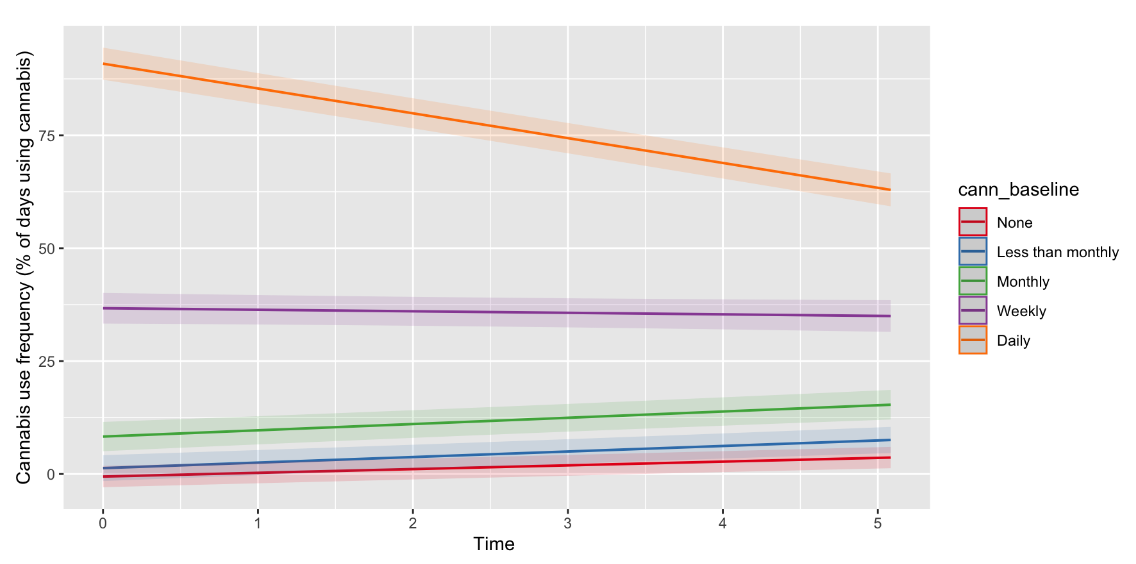
    Question  Did cannabis use or misuse change among adults in the 5 years following recreational cannabis legalization in Canada (overall and by prelegalization cannabis use frequency)?

    Findings  In this cohort study including 1428 adults, cannabis use frequency increased significantly overall while misuse decreased, with small effect sizes for both. Prelegalization cannabis use significantly moderated these changes.

    Meaning  From a public health standpoint, this cohort study found modest changes (both negative and positive) in cannabis use behaviors in the 5 years following legalization in Canada.

    Read more: JAMA Network Open

  • Drug Policy

    The fentanyl epidemic in North America and the global reach of synthetic opioids

    Join the Brookings Institution’s Foreign Policy program for an event to launch the results of a year-long project on synthetic opioids in the United States and abroad. Highlighting the project’s findings and featuring top experts, the event will open with a fireside chat between former New York City Mayor Bill de Blasio and Senior Fellow Vanda Felbab-Brown. Subsequent panels will explore U.S. drugs markets, domestic law enforcement, treatment, harm reduction, and decriminalization policies as well as the international dimensions of synthetic opioids and their spread beyond North America.


  • Drug Policy

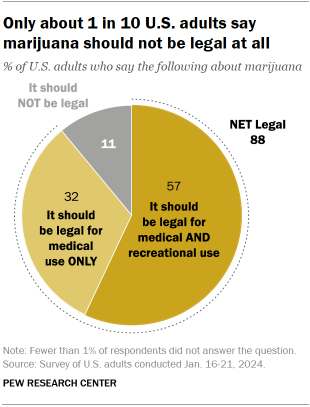
    Most Americans Favor Legalizing Marijuana

    As more states pass laws legalizing marijuana for recreational use, Americans continue to favor legalization of both medical and recreational use of the drug.

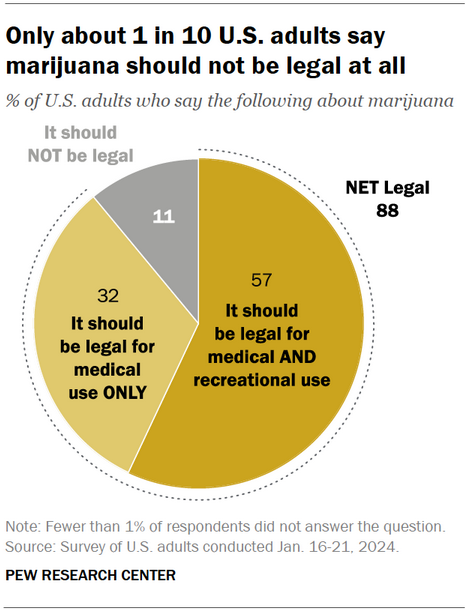
    Pie chart shows Only about 1 in 10 U.S. adults say marijuana should not be legal at all

    An overwhelming share of U.S. adults (88%) say marijuana should be legal for medical or recreational use.

    Nearly six-in-ten Americans (57%) say that marijuana should be legal for medical and recreational purposes, while roughly a third (32%) say that marijuana should be legal for medical use only.

    Just 11% of Americans say that the drug should not be legal at all.

    Read the PEW Survey

  • Drug Policy

    The impact of an unsanctioned compassion club on non-fatal overdose

    Given the total lack of empirical literature describing the effectiveness of compassion clubs as an overdose prevention initiative, the project was subjected to evaluation throughout its operation. Herein we report on the impact of DULF compassion club enrolment on non-fatal overdose rates amongst program participants, and thereby seek to contribute to the literature specific to compassion clubs and non-prescriber-based models of safe supply.