• Cannabis & Hemp

    Police Look For Links In Pot-Shop Killings

    Owners, customers and neighbors of marijuana dispensaries are wary in the wake of two slayings.

    By Joel Rubin and Paloma Esquivel, Los Angeles Times

    June 26, 2010

    The killings of two pot dispensary workers just five hours and five miles apart — one shot in Echo Park, the other apparently stabbed in Hollywood — triggered a police investigation Friday to determine whether they were linked and rattled medical marijuana advocates.

    Two senior Los Angeles Police officials who asked not to be identified because of the sensitivity of the ongoing investigation said Thursday’s slayings appear to be unrelated. But the sheriff and district attorney said their brutality suggests the work of violent gangs.

    The homicides could revive the debate over whether dispensaries make their neighborhoods unsafe, but police could recall only one other slaying at a dispensary. Thursday’s killings occurred as the city is trying to shut down about 400 illegal dispensaries and exert control over approved outlets.

    Police said dispensaries are lucrative targets. “They have a lot of cash,” LAPD Deputy Chief David Doan said at a news conference. “That’s what’s attractive. Any business that does a lot of cash business has that risk.”

  • Hot Off The 'Net - International

    UN, Western Nations Complicit in Drug Of…

    UN, Western Nations Complicit in Drug Offender Executions, Report Says

    from Drug War Chronicle, Issue #638, 6/25/10

    With the United Nations’ International Day Against Drug Abuse and Illicit Trafficking set for tomorrow, the timing couldn’t be better for a new report from the International Harm Reduction Association (IHRA) decrying the complicity of Western governments and the UN Office on Drugs and Crime (UNODC) in international drug control efforts that result in the execution of drug offenders.

    Tehran Take what happened in China on global anti-drug day 2008 as a case in point. As has been its wont in the past, the Chinese government used the occasion to execute numerous drug offenders, including Han Yongwan, a regional trafficker who had been arrested by police in Laos and later extradited to China. Han had been arrested thanks to the East Asian Border Liaison Office program, initiated by UNODC in 1993, and chiefly funded by the United Kingdom (24%), the United States (24%), Japan (24%), and Australia (10%). Other funders included the European Commission (3%), Sweden (3%), Canada (2%), and UNAIDS (5%).

    Although the European Commission and nearly all of the donor nations reject the death penalty, the funding of programs like the East Asian Border Liaison Office means that those governments and organizations are complicit, if inadvertently, in the application of the death penalty to drug offenders, the IHRA found in a report issued this week, Complicity or Abolition? The Death Penalty and International Support for Drug Enforcement.

  • Cannabis & Hemp - Hot Off The 'Net

    Launch of world’s first prescription cannabis medicine

    Porton Down, UK, 21 June 2010: GW Pharmaceuticals plc (GWP:AIM) today announces the UK launch of Sativex®, its Oromucosal Spray for the treatment of spasticity due to Multiple Sclerosis (MS). Sativex® is the world’s first prescription cannabis medicine and the UK is the first country in the world to grant a full regulatory authorization for the product.

    Sativex® contains two cannabinoids or active ingredients – THC (delta-9-tetrahydrocannabinol) and CBD (cannabidiol). It is the first cannabinoid medicine derived from whole plant extracts from the cannabis sativa plant.

    Sativex®, available as a prescription only medicine, was developed by GW in specific response to calls from people with MS for a prescription cannabis-based medicine. Today’s launch means that MS patients suffering the spasms and cramping associated with spasticity have access to a new treatment option which has been shown to improve their symptoms where current treatments have failed.

    Sativex® is manufactured by GW under Home Office licence at an undisclosed location in the UK. The medicine is being marketed in the UK by GW’s UK licensee, Bayer Schering Pharma.

  • Drug Policy

    World Drugs Day June 26

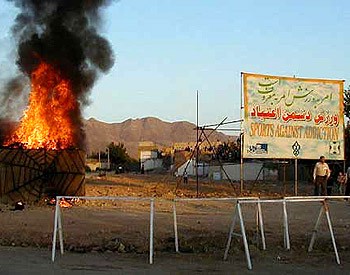
    This film shows the hypocrisy of politicians who remain silent on the issue of drugs despite their own experiences and, more importantly, despite the fact people are executed to commemorate World Drugs Day.

  • Hot Off The 'Net

    In Which Another Drug Warrior Extracts Facts From His Behind

    In Which Another Drug Warrior Extracts Facts From His Behind

    Another drug warrior invents facts. Check the video below from Stossel’s show last week, in which former ONDCP official and narcotics officer Paul Chabot debates former narcotics cop and Law Enforcement Against Prohibition speaker Neil Franklin.

    At one point, Chabot says the “majority” of crimes that take actual victims are committed by people under the influence of illegal drugs. That isn’t true. According to data from Chabot’s former employer, it’s around 22 percent at federal level, and 33 percent at the state level. And of course that doesn’t mean the drugs caused the crimes. Or even contributed to them. Though I’m sure there’s some of both. The only conclusion you can safely draw from those numbers is that there’s some overlap between people who use illegal drugs and people who commit violent and property crimes.

  • Cannabis & Hemp

    US WI: OPED: Lawmakers to Sick People: We Don’t Care

    Newshawk: Is My Medicine Legal YET? www.immly.org
    Pubdate: Thu, 24 Jun 2010
    Source: Isthmus (WI)
    Copyright: 2010 Isthmus
    Webpage: http://www.isthmus.com/isthmus/article.php?article=29634
    Contact: [email protected]
    Author: Gary Storck
    Video: TV commercial http://www.youtube.com/watch?v=IRB1ppPRJ0M
    Bookmark: http://www.mapinc.org/people/Jacki+Rickert

    LAWMAKERS TO SICK PEOPLE: WE DON’T CARE

    Rejection of Wisconsin Medical Marijuana Bill Was a Profile in Cowardice

    Jason Glaspie did everything he could. The former Marine, a veteran
    of the first Iraq war, has endured numerous treatments for brain and
    spinal cancer that left him disabled and often in terrible pain. One
    thing that alleviates his suffering is smoking marijuana.

    And so when it looked as though Wisconsin might join the 14 other
    states (and the District of Columbia) that allow the medicinal use of
    cannabis, Glaspie became an activist for the cause.

    The Fitchburg resident attended hearings and events held in support
    of the proposed bill. He starred in a TV commercial on the issue and
    let his story be told in the press. And, in the end, like hundreds of
    other people in Wisconsin, he was bitterly disappointed. The bill
    died in the just-ended legislative session after state lawmakers
    failed to bring it forward for a vote.

    “The bill’s failure to pass forces patients to make the horrible
    choice between [enduring pain] and being a criminal,” says Glaspie.
    “I should not have to fear prosecution just because I want to move
    around without my cane. People with chronic health issues have enough
    on their plates without adding more fear.”

    But fear is what they are left with. The political structure of the
    state of Wisconsin has given them the back of their hand. Again.

    Just ask former Marine Sgt. Erin Silbaugh (videos here
    http://www.youtube.com/watch?v=MQ2-q5q3zTk and here
    http://www.youtube.com/watch?v=gQw7P0Jkcns ), who served three tours
    in the current Iraq war, returning with severe post-traumatic stress
    disorder. The Lodi resident recalls a conversation with his
    Assemblyman, Rep. Keith Ripp (R-Lodi). He asked if Ripp cared that
    Silbaugh had to risk arrest and jail to treat his service-related
    disability. Ripp, he says, responded by shrugging his shoulders.

    “I’ve been on over 10 different prescriptions provided by the VA to
    control my PTSD since returning from Iraq, each with its own list of
    side effects,” says Silbaugh. “Why won’t the Legislature allow me to
    use something less harmful and more helpful?”

    Why indeed?

    [snip]

    Continues: http://www.mapinc.org/drugnews/v10.n485.a01.html

  • Hot Off The 'Net

    World Drug Report 2010

    WDR2010In 2009, the United Nations Member States decided to make further and decisive progress, within a decade, in controlling illicit drug supply and demand. Many illicit drug markets have reached global dimensions and require control strategies on a comparable scale. In that context, there is a need to better understand these transnational markets and the manner in which they operate. This year’s World Drug Report is a contribution towards that objective. It opens with an analytical discussion of three key transnational drug markets: the markets for heroin, cocaine and amphetamine-type stimulants. The market discussion is followed by a presentation of statistical trends for all major drug categories. The latest information on drug production, seizures and consumption is presented. Finally, there is a discussion on the relationship between drug trafficking and instability.

  • Drug Policy

    Chris Selley: Our indefensibly blood-soaked drug laws

    Jamaican gangster and drug kingpin Christopher “Dudus” Coke, subject of a violent month-long manhunt in the slums of West Kingston, surrendered to authorities on Wednesday without a shot being fired. He happened to be dressed as a woman at the time, police gleefully announced, providing photo evidence — a darkly comic anticlimax to a senseless battle that killed 73 people and wounded 35 more. It’s no exaggeration to say that drug consumers in the world’s leading nations have blood on their hands. Their presidents and prime ministers have more.

    Read more: http://fullcomment.nationalpost.com/2010/06/24/chris-selley-our-indefensibly-blood-soaked-drug-laws/#ixzz0rob7tI38